







 CEO Corner
 HCP Corner





- HCP Marketing: Key Takeaways
- Understanding HCP Marketing: Definition and Formats
- HCP Marketing vs. Healthcare Marketing: What’s the Difference?
- The Importance of HCP Marketing for Pharma Teams
- What Are the Core Components of Effective HCP Marketing?
- Common Challenges Holding Pharma HCP Marketing Back
- How P360 Supports Modern HCP Marketing
- Frequently Asked Questions About HCP Marketing
HCP Marketing: Key Takeaways
- Healthcare professional (HCP) marketing educates and engages clinicians, specialists, pharmacists, and pharma staff members with accurate and compliant clinical information
- It differs from general healthcare marketing in terms of target audience, scientific depth, and evidence-based communication
- Effective HCP marketing is characterized by personalization, data-driven segmentation and performance analytics
- Disconnected systems, low engagement and compliance complexity slow marketing impact
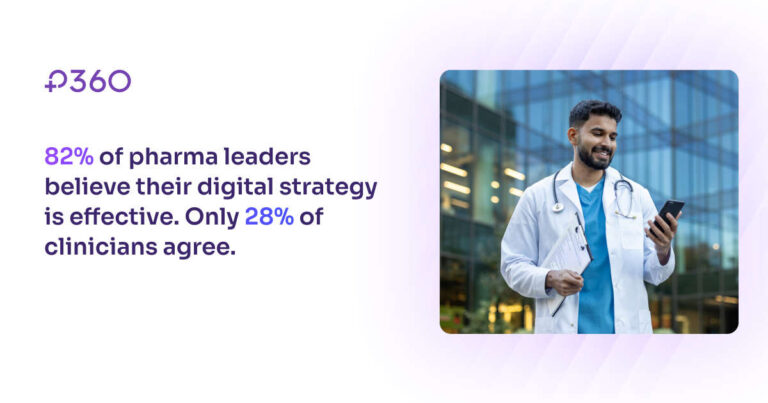
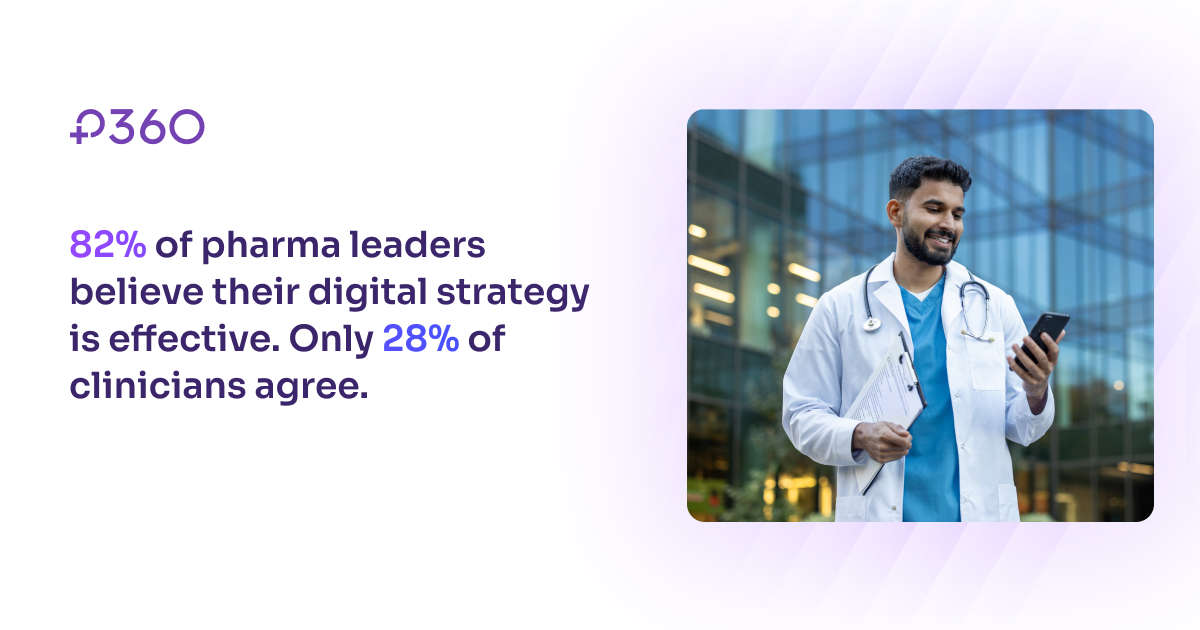
82% of pharma executives believe their digital efforts are effective, but only 28% of clinicians agree.
This gap highlights a growing disconnect in how healthcare professionals are engaged.
So where does HCP marketing fit in?
In this guide, we’ll break down:
- What HCP marketing is
- How it differs from healthcare marketing
- The core elements that make it effective
- The common challenges slowing pharma teams down
Understanding HCP Marketing: Definition and Formats
HCP marketing focuses on engaging licensed healthcare professionals with approved, evidence-backed information.
The communication must align with labeling, safety data, and regulatory standards while supporting informed prescribing decisions.
This type of marketing can come in various formats:
- Clinical trial data sharing
- Case studies
- Product education and launch campaigns
- Safety updates and labeling changes
- Field force enablement materials
- Medical events engagement
The target audience of HCP marketing includes physicians, specialists, pharmacists, nurse practitioners, and other licensed clinicians.
All of them play a direct role in treatment decisions and patient care, which makes accurate, timely, and compliant communication key.
HCP Marketing vs. Healthcare Marketing: What’s the Difference?
Both HCP and healthcare marketing work within the same life sciences industry.
However, they address different audiences, follow different regulatory standards, and serve different strategic objectives.
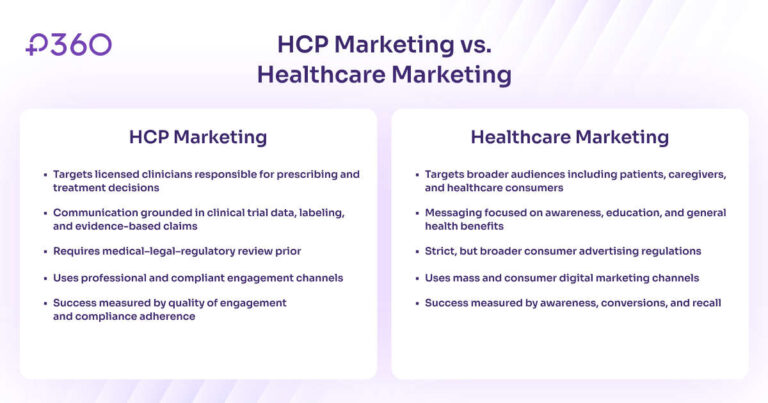
Audience
Healthcare marketing targets a broad audience that may go beyond professionals, including patients, caregivers, and hospital administrators
Its purpose is to build awareness, encourage service utilization, and educate people about various diseases.
HCP marketing’s focus is on licensed healthcare professionals, taking into account their clinical expertise, time constraints, and scientific expectations.
The audience is smaller and more defined, consisting of experts who directly influence prescribing decisions and therapy selection.
Messaging
Healthcare marketing uses accessible, high-level messaging designed for non-clinical audiences.
It may focus on symptoms, quality of life improvements, or general health benefits.
HCP communication must withstand clinical review. It prioritizes trial data, explanations of action mechanisms, and safety and efficacy comparisons.
Regulatory Standards
All healthcare communications are regulated to some degree to ensure information is accurate, balanced, and compliant with regional regulatory authorities.
Healthcare marketing allows more flexibility in tone and framing, provided it meets consumer protection standards.
Communication directed to HCPs must withstand clinical review, with claims grounded in trial data, mechanism-of-action explanations, and balanced safety and efficacy information.
Strategic Objective
Healthcare marketing prioritizes brand perception, awareness building, and patient engagement.
The success of the marketing strategy may be measured through impressions, reach, or increase in brand awareness.
HCP marketing relates directly to commercial performance and clinical adoption, ensuring healthcare professionals understand the clinical value and the appropriate use of different therapies.
Here, success is measured through:
- Prescribing trends across target segments
- Therapy adoption rates within approved indications
- Depth and quality of HCP engagement
- Launch trajectory in competitive markets
- Market share performance over time
Marketing Channels
Healthcare marketing may use mass media, digital advertising, social media campaigns, and public awareness initiatives.
HCP marketing requires a coordinated omnichannel approach to ensure every interaction is aligned and regulatory-approved.
This means integrating:
- Field engagement
- Compliant email communication
- Medical conferences
- Secure messaging platforms
- Centralized reporting systems
The Importance of HCP Marketing for Pharma Teams
Healthcare professionals are harder to reach than ever due to limited in-person access, increasing digital fatigue, and tighter compliance control.
Effective HCP marketing:
- Supports therapy adoption through clinically substantiated communication.
- Improves operational coordination across marketing, medical, and compliance.
- Reduces compliance risks by ensuring documented and review-ready interactions.
- Strengthens decision-making through centralized engagement and performance data.
What Are the Core Components of Effective HCP Marketing?
In practice, effective HCP marketing depends on several coordinated components.
Clear Value Proposition for Clinicians
Instead of relying on promotional messaging, HCP marketing tactics clearly communicate why a therapy matters in real clinical practice.
They deliver relevant clinical evidence and practical insights to help healthcare professionals make informed, confident treatment decisions.
If the clinical value is not immediately clear, even well-executed HCP marketing tactics will struggle to generate meaningful engagement.
Personalized Content
Healthcare professionals expect communication that reflects their specialty, prescribing behavior, and clinical interests.
That’s why HCP marketing:
- Tailors content according to therapeutic focus.
- Adjusts depth of information by specialty.
- Aligns messaging with past engagement.
- Times communication based on interaction patterns.
The goal is to deliver the right information to the right clinician at the right time.
A personalized approach ensures better engagement, increased trust, and higher response rates, supporting stronger long-term HCP relationships.
Data-Driven Segmentation
To be effective, HCP marketing needs to understand who you are engaging and why.
Different healthcare professionals interact in different ways. For example, some may prefer digital content, while others may respond better to field interactions.
Data-driven segmentation allows pharma teams to group HCPs based on specific criteria, such as:
- Medical specialty and subspecialty
- Historical prescribing patterns
- Patient population characteristics
- Prior engagement history
- Preferred communication channels
The result is relevant, on-point messaging and improved engagement rates. Plus, better resource allocation and campaign efficiency.
Instead of sending broad, uniform communication, teams can prioritize high-value segments and tailor outreach accordingly.
Performance Analytics
For pharma teams, data provides visibility into which channels, messages, and touchpoints contribute to meaningful engagement.
Over time, these insights help teams refine outreach strategies while staying compliant.
Common Challenges Holding Pharma HCP Marketing Back
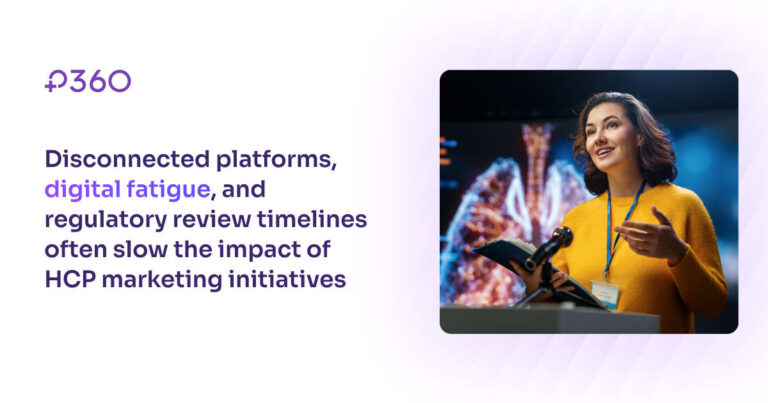
Despite investing in tools and digital initiatives, marketing performance may be slowed due to disconnected systems, compliance complexity, and internal misalignment.
Disconnected Technology Systems
For pharma teams, managing separate systems for CRM, promotional review, and analytics often leads to fragmented visibility.
This can result in duplicated outreach, missed insights, and reduced efficiency.
Low Engagement
Healthcare professionals are bombarded by emails, event invitations, and promotional materials.
Reduced access to in-person meetings and increasing digital fatigue make it even more difficult to gain attention and drive meaningful engagement.
When communication does not feel relevant or clinically valuable, it is quickly ignored.
Siloed Teams
HCP marketing requires coordination between marketing, sales, medical, compliance, and IT.
When there is no alignment, even the best strategies struggle to bring measurable results.
Balancing Speed With Compliance
Launches and competitive pressure require pharma teams to move quickly, while still meeting strict regulatory standards.
Manual reviews slow campaign execution, making it difficult to move faster without adding risk.
How P360 Supports Modern HCP Marketing
P360 is engagement infrastructure purpose-built for life sciences, connecting compliance, communication, and data into one unified platform, not integrated point solutions bolted together.
It empowers pharma teams to:
- Reach HCPs through channels they already use: SMS, WhatsApp, voice, and video, with no app downloads required.
- Prevent compliance violations through architectural controls, not just policy monitoring.
- Gain real-time engagement and performance intelligence with complete attribution.
- Scale execution through pharma-validated AI trained exclusively on approved clinical data.
- Align marketing, sales, medical, and compliance teams on one platform.
Deployed in 50+ countries and trusted by 4 of the top 10 global pharma companies, P360 delivers:
- Up to 98% message open rates vs. 10–30% industry average
- 3× interaction volume increase in pilot deployments
- 45% higher HCP response rates
- Zero compliance violations across all deployed instances
Frequently Asked Questions About HCP Marketing
What is HCP marketing in Pharma?
This is the strategic, compliant engagement of healthcare professionals with accurate clinical and product information to support informed prescribing decisions.
How does HCP marketing differ from healthcare marketing?
Healthcare marketing targets broad audiences such as patients and caregivers. HCP marketing focuses on licensed clinicians. It requires deeper scientific detail and stricter regulatory compliance.
What are common HCP marketing tactics?
Common tactics include clinical data sharing, compliant email campaigns, field engagement, medical conference participation, and coordinated omnichannel communication.