









 CEO Corner
 HCP Corner






Industry guidance on ethical HCP contact data
Pharma companies send compliant SMS to physicians by getting documented opt-in consent before the first text and checking it again at every send. In the US that means prior express written consent for marketing texts under the TCPA and a sending number registered with US carriers (10DLC); in the UK, a specific, unticked opt-in under PECR and UK GDPR. Every message comes from a library approved through Medical, Legal and Regulatory review, carries a working STOP opt-out, and any HCP reply that raises a medical question, side effect or product complaint is routed to Medical Information or pharmacovigilance and archived with the consent record. P360 runs compliant two-way HCP SMS on this model, with approved message templates and reply capture in one record.
Delivery is the easy part of HCP texting. The hard part is a documented, governed reply: a named HCP who recognizes the sender, trusts the channel, knows what kind of reply is welcome, and gets a safe hand-off when the reply raises a Medical Information or pharmacovigilance issue.
The strongest programs treat SMS as an owned engagement channel, not a rented media placement. They preserve consent, control the number, review the message before sending, capture the reply, and retain the full record. Compliance isn’t a tax on engagement. It creates the permission structure that makes two-way engagement possible.
- Why open rates don't measure a compliant HCP SMS program
- What laws apply to pharma SMS to physicians?
- What does a compliant SMS to a physician contain?
- How to capture HCP SMS consent that survives an audit
- Should pharma brands own their HCP SMS numbers?
- The six steps to send a compliant SMS to an HCP
- How to measure replies to compliant HCP SMS
- A 90-day plan to launch compliant HCP SMS
- Frequently asked questions
Why open rates don't measure a compliant HCP SMS program
Commercial teams often read send volume and open rates as engagement. Those numbers confirm delivery and viewing. They do not show whether a physician asked a clinical question, requested follow-up, or trusted the sender enough to reply.
The commercial value of SMS appears in the response record. A useful reply identifies the HCP, clarifies the request, and gives the team a controlled next action. A silent audience produces exposure. A documented exchange can support field follow-up, Medical Information handling, or pharmacovigilance escalation. That difference should shape the program before anyone chooses a messaging vendor.
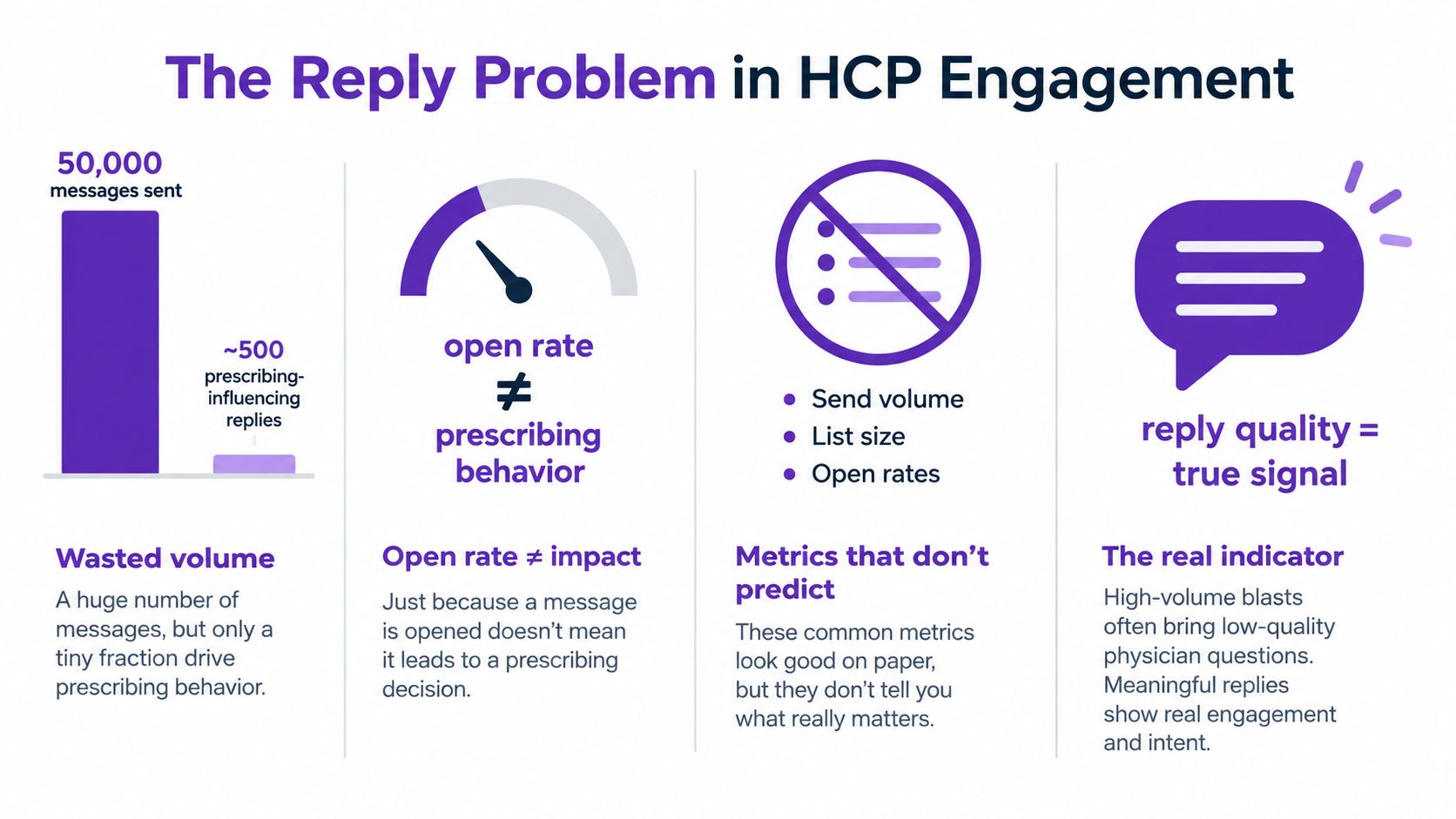
The first design test is straightforward:
Does this design make a thoughtful HCP more likely to respond, or less likely?
Answering it requires more than a consent checkbox. The brand must know which HCP may be contacted, what purpose that person approved, and what content the message can contain. It must also define the destination for an HCP-initiated question. A side-effect report cannot remain with a field representative. An off-label question cannot sit in an unmanaged inbox.
Guidance on non-personal promotion and HCP engagement
Owned numbers, documented consent, and pre-send review directly affect the quality of the conversation. They help the team recognize the sender, apply the approved purpose, and preserve the context when a reply arrives. The record should connect the HCP, consent scope, message, reply, and escalation outcome.
The P360 approach to compliant HCP engagement reflects this shift from broadcast activity to governed conversation. The useful measure is documented two-way engagement with a named HCP, preserved in a record that Medical, Legal, Regulatory, and compliance teams can review without reconstructing the interaction from vendor exports.
What laws apply to pharma SMS to physicians?
Pharma SMS to physicians is governed by the TCPA in the US, with 10DLC carrier registration on top; by PECR and UK GDPR in the UK; and by CASL in Canada. Each sets its own rules for consent before a marketing text and for opting out.
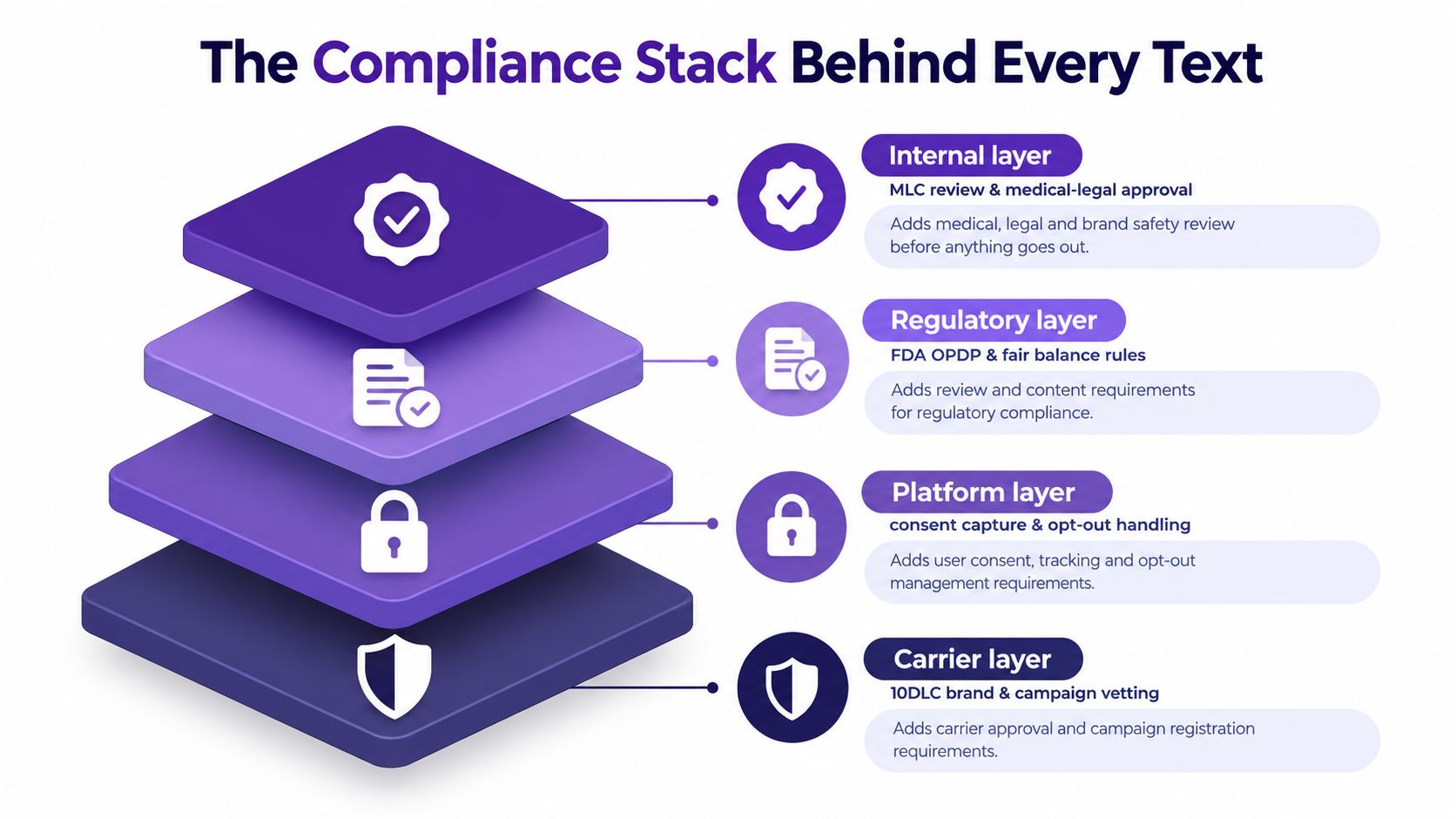
Compliance for HCP texting isn’t a list of acronyms that a vendor can check off. It’s a set of connected controls. Each layer restricts the next one, and a failure in one layer can undermine the entire program.
In the United States, telemarketing texts are covered by the Telephone Consumer Protection Act. The FCC’s TCPA rules (47 CFR 64.1200) require prior express written consent for marketing calls and texts sent using an automatic telephone dialing system or an artificial or prerecorded voice. For pharma teams, that means consent must exist before outreach begins, not after a physician responds.
The TCPA’s health care message exemption does not help here. It covers health care messages sent by or for HIPAA covered entities, such as hospitals, practices and health plans, and their business associates; a drug manufacturer’s marketing text to a physician is not one of them. Written consent under the rule must be signed (an electronic signature counts), identify the phone number, authorize marketing messages from the named seller, and state that agreeing is not a condition of purchase.
The layers that determine whether a text can go out
The carrier layer affects whether registered traffic can reach the intended number. US wireless carriers also require business texts from standard 10-digit numbers to be registered through 10DLC, with the brand and each messaging campaign declared before sending. Registration doesn’t replace consent. It supports the sender identity and campaign purpose that carriers and reviewers need to understand.
The privacy layer governs what the message may contain. Teams need a clear view of whether a text includes clinical, personal, or promotional information and whether the chosen channel is appropriate. Texts to HCPs should never carry information that identifies a patient. The same message also needs to respect pharma controls around approved claims, fair balance, adverse event reporting, and off-label questions.
For UK recipients, PECR and UK GDPR require valid consent that is freely given, specific, informed, and demonstrated through clear affirmative action. The ICO’s guidance calls for an unticked checkbox or comparable opt-in, a clear statement that consent covers text messages, the sender’s name, the message type, and a simple withdrawal route (UK GDPR and PECR SMS guidance). Canada brings its own express consent requirements under CASL, which makes cross-border design a governance problem rather than a copywriting exercise.
One architecture is safer than separate controls
The brand should connect the layers in one operating design:
- Consent at intake: Capture channel, purpose, sender, timestamp, and withdrawal terms before the first marketing message.
- Purpose at storage: Preserve the exact use case. A safety communication approval should not automatically become permission for promotional content.
- Review before send: Validate consent scope, approved claims, recipient status, and escalation readiness.
- Retention at sunset: Keep message history, consent checks, replies, and opt-outs in a reviewable record for the required retention period.
P360 compliance governance model
The P360 Approved Content model is relevant to this operating principle because governance must sit inside the communication process. A review that happens only after a complaint is detection, not prevention.
Industry guidance on HCP engagement solutions
What does a compliant SMS to a physician contain?
A compliant SMS to a physician names the sender, stays within the purpose the HCP consented to, and uses only wording approved through Medical, Legal and Regulatory (MLR) review. It also tells the HCP how to reply and how to stop. Every text should include:
- Sender: the company or brand name, so the HCP recognizes who is texting.
- Purpose: a message type the HCP’s consent covers.
- Approved content: MLR-approved wording only, with a link to full Prescribing Information and Important Safety Information when the text makes a product claim.
- Reply path: what kind of reply is welcome and who will answer it.
- Opt-out and help: “Reply STOP to opt out, HELP for help.”
- No patient information: nothing that identifies a patient.
A compliant HCP text follows this structure. Every live message still needs its own MLR approval.
[Company]: [approved message]. Full Prescribing Information and Important Safety Information: [link]. Reply with a question and [role] will answer. Reply STOP to opt out, HELP for help.
How to capture HCP SMS consent that survives an audit
A consent checkbox proves almost nothing by itself. An audit-ready record shows who consented, to what, through which channel, when, and how the person can revoke permission.
The capture form should make those answers obvious. At minimum, it should associate the HCP’s mobile number with the legal entity sending the message, the approved message category, the exact opt-in language, the source of the form, and the date and time of the action. An IP address or equivalent source record can help establish how the consent was collected, but the key point is traceability.
Consent also needs to be granular. Permission for safety information doesn’t automatically authorize promotional updates, sample coordination, or rep follow-up. The storage model should preserve each purpose separately and suppress a message when the proposed use falls outside the approved scope. An audit-ready consent system keeps centralized consent records, channel-specific approval, message logs, continuous auditing, and timestamped proof of consent and opt-out status.
The form should read like an evidence record
A practical form can use a clear disclosure beside an unticked opt-in control:
SMS consent: The HCP agrees to receive the stated category of messages from the identified sender at the supplied mobile number. The HCP can withdraw consent through the stated opt-out method.
The final language needs review for the market, sender, purpose, and message type. The system should then preserve the exact version shown to the HCP, rather than storing only a later template.
| Field | Why It Matters |
|---|---|
| HCP mobile number
|
Ties permission to the destination number used for outreach.
|
| Sending legal entity
|
Identifies who received permission to communicate.
|
| Message purpose
|
Separates promotional, clinical, safety, sample, and rep follow-up use cases.
|
| Exact opt-in language
|
Shows what the HCP actually agreed to receive.
|
| Date and time
|
Establishes that consent preceded the send.
|
| Form source or IP record
|
Documents where and how the action occurred.
|
| Consent status and scope
|
Prevents messages outside the approved purpose.
|
|
Opt-out history
|
Shows when permission was withdrawn and whether suppression followed.
|
| STOP and HELP activity
|
Demonstrates that revocation and assistance paths worked.
|
Revocation belongs in the first release
STOP and HELP handling shouldn’t be added after launch. A STOP response should trigger suppression, record the event, and create an acknowledgment where appropriate. The suppression status must sync quickly enough to prevent another campaign from treating the HCP as eligible.
The consent record should also be tamper-evident. Immutable logging, cryptographic hashing, or WORM storage can prevent quiet edits before a regulator asks for the record. A reviewer should be able to understand the complete history in under two minutes, without relying on a vendor’s explanation.
Should pharma brands own their HCP SMS numbers?
Pharma brands should own their HCP SMS numbers where they can, because ownership keeps the consent file, message history and replies under the brand’s control
The commercial difference between owned engagement and a rented network is control. In an owned model, the pharma brand provisions the number, manages registration, holds the consent file, and retains the message and reply history. In a rented model, the vendor’s identifiers and systems carry the relationship, which can make proof and portability dependent on the contract.
Owning the number matters most when an HCP SMS program is audited or changes vendor.
A brand should be able to show the consent lineage, export the conversation record, and explain who controls the channel. If a vendor holds the number and the replies, the brand may have access without having true ownership.
| Dimension | Owned Numbers | Rented Networks |
|---|---|---|
| Data portability
|
The brand retains the number and can export consent, messages, and replies in a usable record.
|
The vendor controls key identifiers and may control how history is exported.
|
| Audit exposure
|
The brand can present one lineage from HCP consent to message to reply.
|
The brand may depend on a third party to prove what happened.
|
| Sender recognition
|
HCPs can build familiarity with a stable brand-controlled number.
|
The sender identity may change with the vendor or campaign arrangement.
|
| Reply intelligence
|
Conversation history remains available for future segmentation and service design.
|
The vendor may retain the interaction context or make it difficult to reuse.
|
| Contract exit
|
The number and records remain part of the brand’s communication estate.
|
Migration can mean rebuilding identity, records, or workflows.
|
| Launch speed
|
Registration and governance take deliberate preparation.
|
A third party may launch faster, but the brand accepts more dependency. |
The faster launch is often the seductive part of a rented network. The hidden cost is weaker control over the evidence and the learning. A physician’s reply is not just an operational ticket. It can reveal what the HCP needs, what content creates confusion, and where Medical Affairs should intervene.
The practical recommendation is direct: own the number, own the consent file, and treat the communication service as infrastructure rather than a media buy. P360’s SMS and WhatsApp communication capability is one example of a communication service designed around two-way HCP contact, but the governance standard should apply regardless of the provider selected.
The six steps to send a compliant SMS to an HCP
The six steps to send a compliant SMS to an HCP are: draft in an approved library, check claims and balance, log Medical, Legal and Regulatory approval, verify consent at send time, route inbound replies, and archive the complete record.
Compliance lives in the message lifecycle, not in the final text alone. A message can contain approved language and still create risk if the wrong HCP receives it, the consent check is missing, or an important reply disappears into an unmanaged inbox.
The six controls that matter
Pharma sales representative communication compliance
1. Draft in an approved library. The author starts with content that has already passed the brand’s review process. Claims, references, fair balance, and any required risk information should be available in the controlled version. Field teams shouldn’t improvise promotional language inside a live text thread.
2. Check claims and balance. The review should confirm that the proposed message matches the approved indication and includes the required information for its use. A short format doesn’t remove the obligation to communicate responsibly. If the message can’t carry the necessary context, it may not belong in SMS.
3. Log Medical, Legal, and Regulatory approval. Approval needs a named reviewer, timestamp, version, market, and intended audience. The system should prevent an old version from being sent after a newer one replaces it.
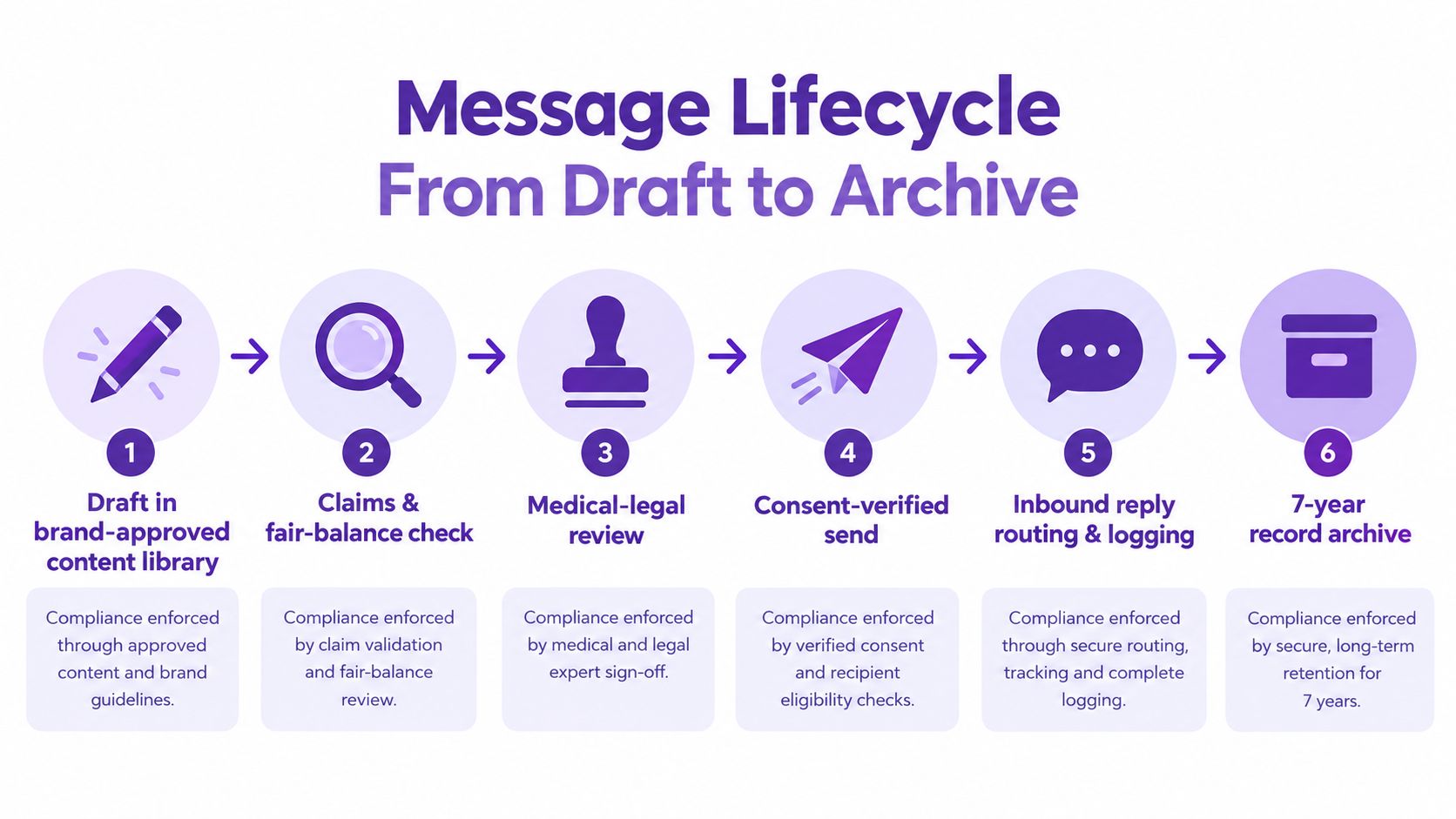
4. Verify consent at send time. The send engine should check the recipient’s identity, channel permission, message purpose, opt-out status, and any applicable quiet-hour rule. Registration supports delivery, but it doesn’t authorize outreach. The consent record does that.
5. Route inbound replies. Every reply should be captured and classified. A clinical question should reach Medical Information. A possible adverse event should follow the pharmacovigilance procedure. A product complaint should go to the designated product complaint intake. A field representative needs a clear hand-off when a reply mentions a side effect.
A message format doesn’t change the rules. Rep texting needs the same supervision, training, escalation and full message capture as any other channel, across SMS and consumer messaging apps. Archiving after the fact isn’t enough if the reply has already been missed or mishandled.
6. Archive the complete record. The archive should include the approved message version, approval evidence, recipient and consent check, delivery event, reply content, routing action, and final disposition. Retention periods follow the company’s legal and regulatory record-keeping policy, and the archive should enforce them automatically. A tamper-evident record gives reviewers a coherent story instead of a collection of screenshots.
Operational rule: The field team should never have to decide alone whether a reply is an adverse event, an off-label question, or a routine commercial request.
How to measure replies to compliant HCP SMS
A compliant HCP SMS program is measured by reply rate, not open rate: whether consented HCPs answer, and what happens to each reply.
Physicians don’t reply because a brand sent more messages. They reply when the sender is recognizable, the channel feels sanctioned, and the question has a clear path to an answer. Documented consent, owned numbers, and pre-send review work together to create that trust.
The reply program should measure more than opens. It should show whether the right HCPs opted in, whether the confirmation process completed cleanly, and whether the replies contain useful clinical or commercial signals. It should also show what happens after the reply.
A practical measurement view includes:
- Opt-in confirmation quality: Whether the HCP’s consent is complete, channel-specific, and usable for the intended purpose.
- Clinical question depth: Whether the response is a meaningful question, a request for evidence, or a simple acknowledgment.
- Sample request fulfillment: Whether an eligible request reaches the correct operational team and receives a documented outcome.
- Medical routing: Whether a reply with clinical content reaches a Medical Information agent rather than remaining with marketing.
- Safety escalation: Whether a potential side effect or product complaint follows the approved pharmacovigilance or product complaint process.
- Suppression accuracy: Whether STOP requests prevent subsequent sends and remain visible in the audit record.
Each of these six measures tracks both compliance and HCP replies. A high response volume can hide poor handling. A smaller number of well-routed replies can teach the brand more about HCP needs and content quality.
The commercial risk is also asymmetric. One mishandled off-label question can damage confidence in the channel and make future replies less likely. An audit-ready program protects the brand, but it also signals to the HCP that the organization knows how to handle a serious question.
The strongest SMS program doesn’t ask for attention first. It earns the right to receive an answer.
An owned number keeps the HCP conversation history with the brand, so each exchange improves the next.
A 90-day plan to launch compliant HCP SMS
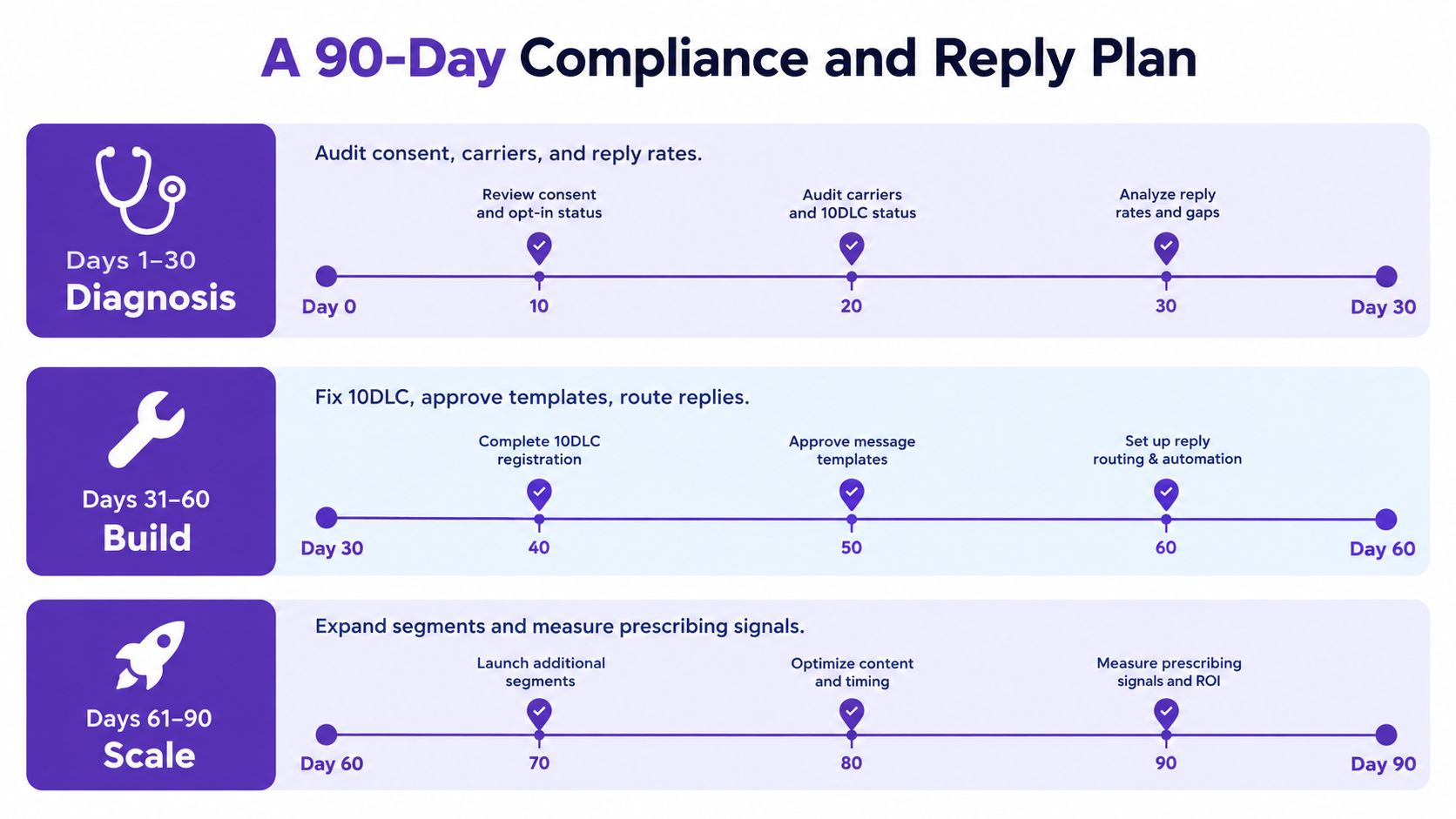
A fiscal quarter is enough to diagnose the current program, fix the control gaps, and activate a disciplined pilot. The work should be owned by a commercial lead with Medical, Legal, Regulatory, IT, compliance, and pharmacovigilance at the table. Vendor delivery milestones aren’t the outcome. Governance wins and reply evidence are.
Days 1 to 30, diagnose
The first block is an inventory exercise. The team should pull every active HCP texting program, identify every sender and number, and map each recipient record to its consent evidence. The review should test whether the consent names the channel, states the purpose, precedes outreach, and includes a functioning withdrawal path.
The team should also document the current reply path. Where do replies land? Who reviews them? How does a potential adverse event reach pharmacovigilance? Which inbox receives a product complaint? If the answers depend on an individual remembering a process, the process isn’t ready.
The output is a gap register with a governance owner and a reply measure for each issue. A missing timestamp is a consent-control gap. An unclassified reply is a routing gap. A message sent from an unowned number is a channel-control gap.
Days 31 to 60, build
The second block fixes the architecture. Standardize the consent form and message-purpose taxonomy. Retire rented short codes where the brand can’t control the number or obtain a complete record. Register the brand and campaign through the applicable carrier process, including U.S. 10DLC requirements where relevant.
Then establish a pre-send queue. Medical, Legal, and Regulatory approval should be visible, versioned, and tied to the intended market and audience. The send process should check consent scope and suppression status automatically.
Days 61 to 90, activate
The final block deploys the owned numbers through two controlled reply campaigns. Each campaign should have a defined HCP segment, approved content, a named responder, and an escalation path for clinical questions, adverse events, off-label content, and product complaints.
By the end of the quarter, the team should be able to answer five questions with evidence:
- Who may be contacted? The consent file and suppression record provide the answer.
- Why may they be contacted? The purpose and channel scope are documented.
- What was sent? The approved version and approval trail are preserved.
- What did the HCP say? The complete reply is captured.
- What happened next? The routing and disposition are recorded.
P360 offers compliant two-way SMS communication for HCP engagement, including approved message templates and reply capture. Teams evaluating it should judge the offering against these governance requirements, not against send volume.
Frequently asked questions
How do pharma companies send compliant SMS to physicians?
Pharma companies send compliant SMS to physicians by capturing documented opt-in consent before the first text, registering the sending number with US carriers, sending only messages approved through Medical, Legal and Regulatory review, with a STOP opt-out, checking consent at every send, and routing any reply about a medical question, side effect or complaint to Medical Information or pharmacovigilance.
Do pharma companies need written consent to text physicians?
Yes, for marketing texts in the US. Under the TCPA, a pharma company texting a physician’s mobile number for marketing generally needs prior express written consent that is signed, names the company, identifies the number and authorizes marketing messages. The TCPA’s health care message exemption covers HIPAA covered entities such as hospitals, not drug manufacturers.
What is 10DLC registration for pharma SMS?
10DLC registration is the US carrier process for business texts sent from standard 10-digit phone numbers. A pharma company registers its brand and each messaging campaign, including its purpose and sample messages, before texting physicians. 10DLC registration supports delivery and sender identity, but it does not replace the HCP’s consent, which is still required.
What happens when an HCP replies STOP to a pharma text?
When an HCP replies STOP to a pharma text, the company must stop sending messages from that program to that number. It should log the opt-out with a timestamp, send one confirmation and sync the opt-out across every campaign right away, so no other program treats the HCP as eligible. The opt-out stays in the audit record.
Where should an HCP’s text about a side effect go?
An HCP’s text about a possible side effect should go straight to the company’s pharmacovigilance process, not stay with a field representative or the marketing team. The SMS system should flag the reply, route it to the safety team, and archive the message, the routing action and the outcome with the HCP’s consent record.
Pharma teams can use P360 to manage compliant SMS conversations with HCPs, preserve reply history, and connect each interaction to the right operational path. Visit P360 to assess how owned numbers, consent governance, and two-way communication can fit the next HCP engagement program.